Microsoft Teams Direct Routing Compliance in the UAE: TDRA Rules, PSTN Risk, and What Businesses Need to Check
Learn how Microsoft Teams Direct Routing fits within the UAE TDRA VoIP framework, what compliance risks apply to PSTN connectivity, and what businesses should review before deployment.

Dubaitech
Unified Communications Team
Microsoft Teams Direct Routing Compliance in the UAE: TDRA Rules, PSTN Risk, and What Businesses Need to Check
Many businesses in the UAE want to use Microsoft Teams Direct Routing so employees can make and receive business calls inside Teams using existing company numbers, SIP trunks, and voice infrastructure.
From a technical point of view, Microsoft Teams Direct Routing is flexible. From a UAE regulatory point of view, however, the real question is not just whether Microsoft Teams works. The real question is whether the voice service and PSTN connectivity behind the deployment are structured in line with the UAE telecommunications framework.
This is where many online articles become inaccurate. They often say "Microsoft Teams is allowed in the UAE" and stop there.
That statement is incomplete.
Microsoft Teams is currently listed by the UAE regulator as an allowed VoIP application. But that does not automatically mean every Direct Routing design, foreign SIP trunk, or PSTN breakout model is compliant.
This guide explains the practical compliance difference.
Important note: This article is a technical and operational summary for businesses planning Teams voice deployments in the UAE. It is not legal advice, and businesses with higher compliance exposure should obtain formal regulatory and legal guidance before launch.
The Short Answer
Yes, Microsoft Teams Direct Routing can be deployed in the UAE.
But the public voice side of the deployment should be assessed under the UAE TDRA VoIP framework.
In practical terms:
- Microsoft Teams as an application is allowed.
- VoIP services offered to users are regulated telecommunications activities.
- PSTN connectivity, numbering, and call termination should be reviewed separately from the Microsoft 365 setup.
- Businesses should not assume that any low-cost foreign SIP trunk connected to Teams is automatically compliant in the UAE.
That distinction matters more than the Teams configuration itself.
1. VoIP Services Are Regulated in the UAE
The UAE telecommunications framework treats VoIP services as telecommunications services. When VoIP is offered to subscribers or connected into public telephony, the service is no longer just a software feature. It becomes part of a regulated telecom environment.
For businesses, that means the compliance review should focus on more than:
- Microsoft 365 licensing
- Teams Phone enablement
- SBC setup
- dial plans and voice routes
The business also needs to ask:
- Who is providing the voice service?
- Where does PSTN connectivity come from?
- How are UAE numbers handled?
- How is voice traffic terminated into the UAE?
This is the part many Teams articles ignore.
2. Microsoft Teams Being Allowed Does Not Automatically Approve Every Direct Routing Architecture
This is the most important point in the article.
It is accurate to say:
Microsoft Teams is currently listed in the UAE as an allowed VoIP application.
It is not safe to say:
- Microsoft Teams Direct Routing is automatically TDRA approved in every form
- any foreign SIP trunk can be connected to Teams for UAE business calling
- a technically working Direct Routing configuration is automatically compliant
Why?
Because technical capability and telecom regulatory compliance are not the same thing.
Microsoft allows Direct Routing to connect Teams to certified SBCs, PSTN trunks, and third-party telephony infrastructure. That is a technical capability. It does not override UAE rules governing public telecommunications services, licensed voice providers, or PSTN connectivity.
That distinction should be understood before the project begins, not after rollout.
3. Direct Routing Should Be Split Into Two Separate Compliance Questions
When UAE businesses evaluate Teams voice projects, it helps to split the design into two layers.
Layer 1: The Collaboration Application
This includes:
- Microsoft Teams
- Teams Phone
- user calling features
- call transfer, queues, voicemail, and presence
Layer 2: The Public Voice Service
This includes:
- SBC connectivity
- PSTN breakout
- SIP trunk source
- UAE phone numbers
- call termination to landlines and mobiles
- inbound calls from public networks into Teams users
In most UAE deployments, Layer 2 is where the real compliance question sits.
A company can have a perfectly valid Teams tenant and a well-configured Direct Routing setup, but still need to review whether the PSTN side of the architecture aligns with the UAE telecom framework.
4. Why Foreign SIP Trunks Need Extra Caution
One of the most common questions is:
Can we connect an international SIP provider to Teams Direct Routing in the UAE?
The practical answer is:
Do not assume it is compliant simply because Microsoft technically supports the connection.
A foreign or low-cost international SIP trunk might work from a technical standpoint. But the ability to connect the trunk is not the same as confirming that the public voice arrangement is appropriate for UAE use.
This becomes especially important where the deployment involves:
- UAE geographic or business numbers
- inbound UAE customer calls
- outbound calls to UAE mobiles or landlines
- voice termination into the UAE public network
If a company wants to use Teams as a true business phone system in the UAE, the PSTN side should be reviewed carefully rather than treated as a generic global SIP exercise.
5. A Safer Architecture for UAE Teams Voice Deployments
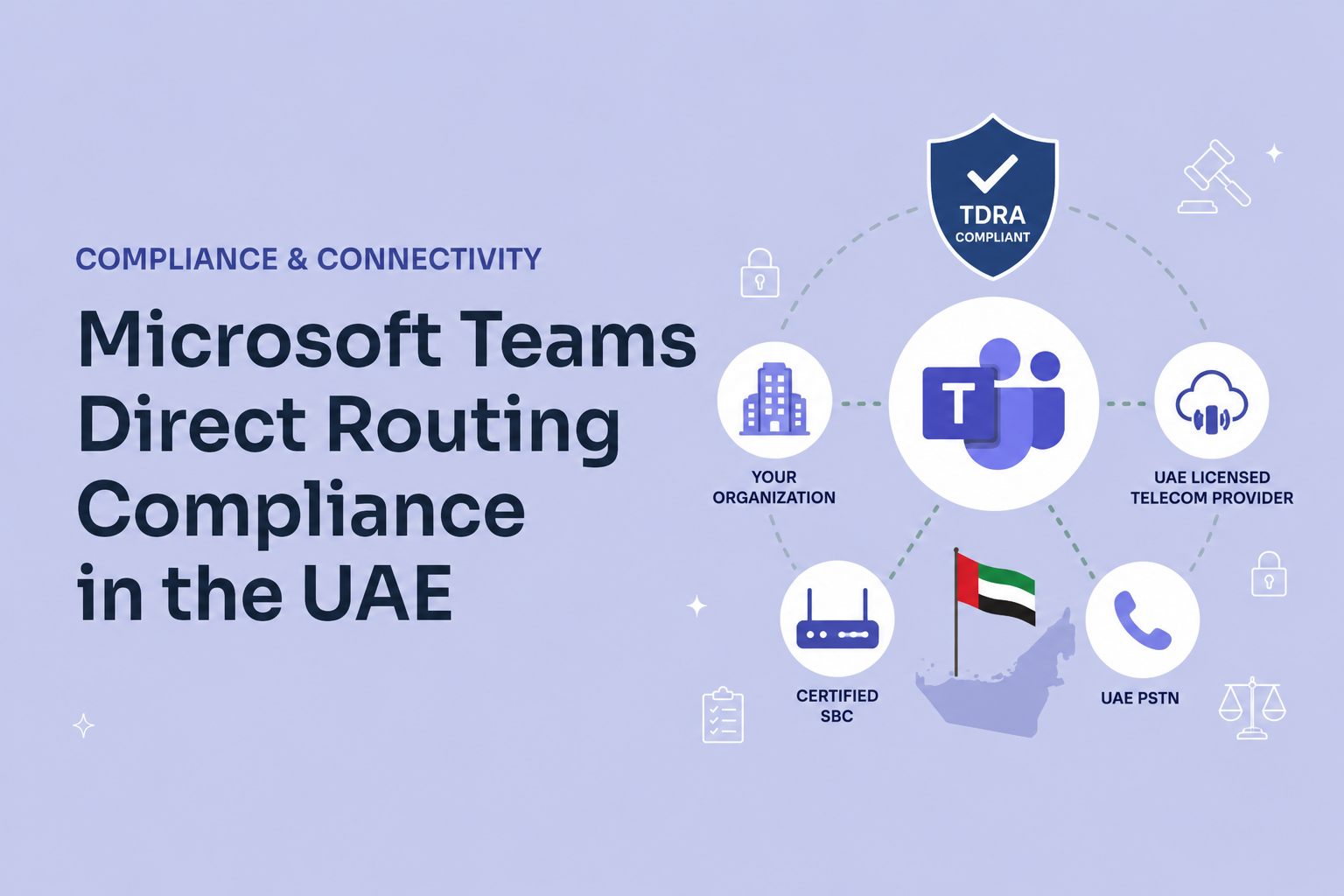
For many UAE businesses, a lower-risk model looks like this:
Microsoft Teams
↓
Microsoft-certified SBC
↓
UAE business voice service arrangement
↓
UAE PSTN
This type of structure separates:
- Teams as the collaboration and calling interface
- the SBC as the interconnection layer
- the regulated voice side as the public telephony path
From a technical delivery point of view, Dubaitech can help with:
- Teams Phone planning
- SBC deployment
- dial plans
- routing policies
- user migration
- number assignment
- testing
- ongoing managed support
But the regulated voice service itself should be positioned through the appropriate provider arrangement rather than casually described as just another cloud app feature.
6. What About a UK or Global Microsoft 365 Tenant?
This is a very useful question for multinational businesses.
Many regional or international companies operate with:
- a UK tenant
- a European Microsoft 365 tenant
- a global Microsoft 365 environment
The compliance concern for UAE Teams calling is not automatically the country of the tenant.
The bigger issue is usually:
- how PSTN connectivity is provided
- what voice provider arrangement is used
- how UAE numbering is handled
- how calls connect into the UAE public network
So if a multinational company has a global Microsoft 365 tenant but the UAE voice side is designed properly, the tenant location alone is not usually the most important starting point in the telecom review.
That is good news for international businesses expanding into Dubai.
7. Internal VoIP and Public Calling Are Not the Same Thing
Some businesses assume that if users are only calling colleagues in Teams, the deployment is automatically treated the same as a full phone system.
That is not a safe assumption.
There is a real difference between:
- internal company communications
- isolated private communication environments
- public calling into landlines and mobile numbers
Once the business wants:
- Teams user to call a mobile number
- Teams user to call a landline
- customers to call a Teams user from the public network
the design is no longer just an internal collaboration feature. It has a public telephony element, and that is exactly why the PSTN side deserves separate review.
8. Dubaitech Can Be the Integrator Without Claiming to Be the Carrier
This is an important positioning point for the blog and for Dubaitech commercially.
Dubaitech does not need to present itself as a telecom carrier to deliver value in a Teams Direct Routing project.
The better and more accurate role is:
- Teams voice integration partner
- Microsoft collaboration and telephony implementer
- SBC deployment and configuration specialist
- managed support and migration partner
This includes work such as:
- Direct Routing design
- Teams Admin Center configuration
- dial plan creation
- voice routing configuration
- SBC setup
- user onboarding
- test call validation
- reporting and support
Safer wording for the website and sales conversations is:
Dubaitech acts as a Microsoft Teams voice integration and managed services partner. PSTN and regulated telecommunications services are delivered through the relevant provider arrangements.
That is stronger and more credible than making broad claims about being the voice operator itself.
9. Hardware and SBC Considerations Should Not Be Ignored
If the solution includes hardware such as:
- physical SBC appliances
- voice gateways
- PSTN edge hardware
- telecom-connected voice devices
then hardware approval and telecom equipment considerations should also be reviewed as part of the implementation plan.
This is especially relevant when the hardware connects with public telecom infrastructure rather than being a purely internal lab or isolated network component.
For Azure-hosted or software-based SBC deployments, the practical review may look different from physical appliance projects, but the business should still treat telecom-facing infrastructure as a compliance workstream, not just a technical purchase.
10. What UAE Businesses Should Check Before Going Live
Before enabling business calling in Teams, review these points:
- Is Microsoft Teams being used only internally, or as a public phone system?
- Where will PSTN connectivity come from?
- Who is responsible for the voice service arrangement?
- Are UAE business numbers part of the design?
- Is the SBC architecture documented and tested?
- Are call flows, IVR, queues, and failover paths defined?
- Has the business separated Microsoft licensing from telecom compliance review?
- If hardware is involved, has telecom-facing equipment been reviewed appropriately?
These questions are especially important for:
- multinational companies launching UAE offices
- businesses replacing a PBX with Teams
- companies using hybrid Teams and SIP environments
- firms trying to reduce cost by using non-local SIP paths
Final Recommendation
Microsoft Teams Direct Routing can absolutely be a strong solution for UAE businesses, but it should not be treated as a simple plug-and-play VoIP shortcut.
The safest way to think about it is this:
- Teams may be the allowed collaboration application
- Direct Routing may be the technical integration model
- but PSTN connectivity, voice service structure, and UAE public telephony still require separate attention
If your business wants to use Microsoft Teams as a real phone system in the UAE, design the solution with compliance in mind from the beginning rather than assuming that technical compatibility equals telecom approval.
Dubaitech can help assess your Teams voice design, SBC requirements, number strategy, dial plans, routing model, and operational deployment approach for the UAE.
Talk to Dubaitech about Microsoft Teams Direct Routing in the UAE or contact us for a Teams voice architecture review.
Need help applying this in your business?
Dubaitech helps UAE businesses turn IT guidance into secure, reliable infrastructure with practical support from certified engineers.
Google Preferred Sources
Prefer Dubaitech on Google
Choose Dubaitech once to help Google surface our latest UAE IT guides when relevant.