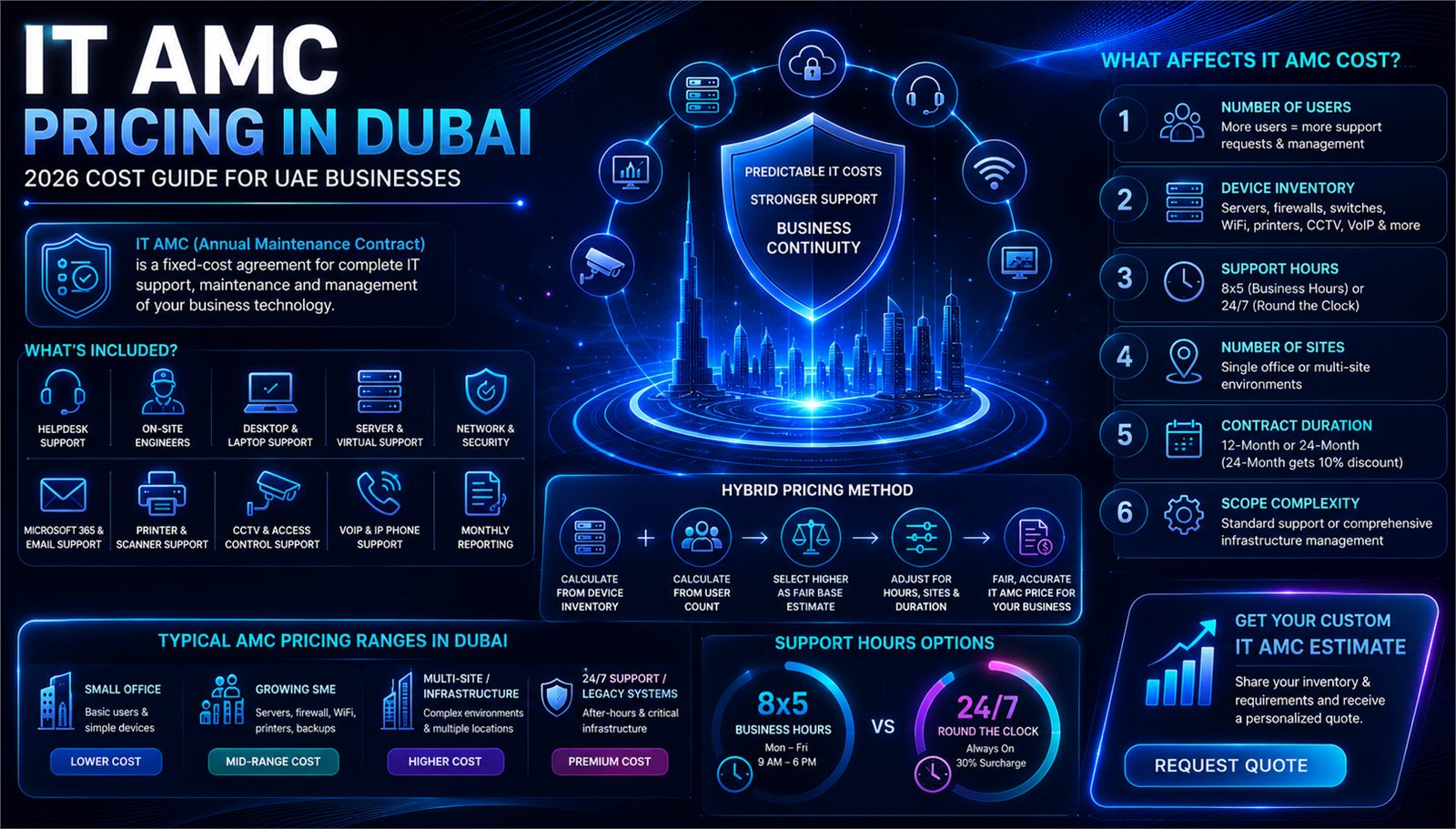
IT Asset Inventory Checklist for AMC Onboarding in Dubai
Prepare your IT AMC onboarding in Dubai with an asset inventory checklist covering devices, cloud services, ownership, support boundaries and handover.

Dubaitech
IT Services

Before an IT annual maintenance contract starts, prepare a verified list of the users, devices, systems, cloud services and locations that need support. For each item, record who owns it, its business purpose, its support status and whether the proposed contract includes it. An inventory gives both teams a concrete basis for agreeing scope; a device count alone does not.
This IT asset inventory checklist is for UAE business owners, office managers and IT leads preparing a new support agreement or a provider handover. It complements Dubaitech's IT AMC services in Dubai, where coverage, service hours, response targets and exclusions are confirmed in the agreed contract.
What should an IT AMC inventory include?
Start with equipment, then connect it to the services your business uses. A laptop may depend on an identity account, an email subscription, a wireless network and a business application maintained by another vendor. Listing those dependencies helps identify who should act when a problem crosses support boundaries.
Use the following fields as a starting point. Keep detailed identifiers in an access-controlled register, and share only a summary in an initial enquiry.
| Inventory area | Information to record | Scope question to resolve |
|---|---|---|
| Users and sites | Supported user count, locations, departments and working patterns | Are remote staff and branch visits included? |
| Computers | Asset reference, model, operating system, assigned role, location and warranty status | Which devices are supported, and which need assessment first? |
| Servers and storage | Physical or virtual role, platform, owner, dependencies and vendor support | Who administers the system and who handles hardware faults? |
| Network equipment | Firewall, switches, access points, controller and circuit ownership | Where does customer equipment end and provider responsibility begin? |
| Cloud and subscriptions | Service, tenant owner, licensing contact, renewal date and support owner | Does the agreement include administration, licensing or only escalation? |
| Business applications | Application, business owner, vendor and support contract | Does Dubaitech troubleshoot the platform, coordinate the vendor, or both? |
| Backup and recovery | Protected systems, backup owner, job oversight and latest restore evidence | Are monitoring, restore assistance and recovery exercises separately defined? |
| Shared equipment | Printers, meeting-room devices, phones and other connected equipment | Are these covered or maintained by a specialist? |
Build the register before agreeing the support scope
1. Assign one inventory owner
Choose a person responsible for reconciling the information and recording changes. Ask department owners to confirm the systems they rely on, including services purchased outside the central IT process. Record when each entry was last checked and where the information came from.
A procurement list shows what was bought. A useful support inventory also shows what is still in use, where it is, and who can authorize work on it. Keep retired equipment separate so it is not accidentally counted as active support scope.
2. Reconcile records with the actual environment
Compare purchase records with approved device-management exports, existing documentation and a physical review where appropriate. Investigate differences rather than silently choosing the largest or smallest count. A device may be in storage, assigned to a remote worker, duplicated in a management tool or awaiting disposal.
Discovery tools can help, but they may miss switched-off devices, isolated networks or services outside their access. Any discovery activity should have customer authorization and an agreed technical boundary.
3. Identify unsupported systems and unresolved issues
Record known faults, expired support, uncertain licensing and systems whose owner cannot yet be confirmed. Mark the status as unknown when evidence is missing. Avoid treating an incomplete inventory as proof that every device is healthy or supportable.
For each exception, agree an owner and next action. The proposal may require remediation, vendor assistance, replacement assessment or an explicit exclusion before recurring support begins. The inventory itself does not guarantee eligibility for an AMC.
4. Map responsibilities, not just products
A cloud service may have separate owners for billing, tenant administration, security settings and user support. A firewall may be customer-owned while the internet circuit remains under a carrier's control. Record those distinctions so an incident can reach the correct team.
Use role-based contact references where possible. The detailed escalation directory can be maintained separately with access limited to the people who need it.
5. Review the asset list against the proposal
For each asset group or service, mark the proposed treatment: included, excluded, vendor-coordinated or awaiting assessment. Then confirm service hours, support channels, site attendance, preventive tasks and the escalation process against that scope.
Keep response targets distinct from resolution commitments. A response can begin while a fix still depends on replacement parts, vendor investigation, customer approval or a change window. For the wider budgeting discussion, see the IT AMC pricing guide.
Keep credentials out of the inventory
Do not put passwords, recovery codes, private keys or license activation secrets into a spreadsheet used for quotation. Record the authorized custodian and the agreed access process instead. Administrative access should be arranged separately through an approved secure method, with the permissions needed for the agreed work.
An inventory can also reveal internal system names, software versions and infrastructure layout. Limit its recipients, store it in an approved location and agree how outdated copies will be handled. A public contact form is suitable for a summary of the requirement, not a complete sensitive infrastructure register.
Keeping track of assets is also a recognized security practice: the Center for Internet Security addresses enterprise assets in CIS Control 1 and software assets in CIS Control 2. This onboarding checklist is a practical scope-planning aid; completing it does not establish certification or compliance.
Agree what the onboarding handover will contain
Before the service starts, review these outputs with the proposed support provider:
- A dated inventory with an identified owner and unresolved entries clearly marked.
- An agreed list of supported users, sites, systems and services.
- Explicit exclusions and responsibilities retained by the customer or another vendor.
- A separate approved access process and escalation directory.
- Known issues, remediation actions, dependencies and acceptance decisions.
- The maintenance, reporting and inventory-update responsibilities stated in the agreement.
An illustrative example: an office laptop could be included for operating-system support while its accounting application remains vendor-maintained. The support provider might diagnose connectivity and coordinate escalation, but application changes would still require the relevant vendor's involvement. That boundary belongs in the scope before a ticket occurs. This example is not a Dubaitech customer case study.
Keep the inventory useful after onboarding
Agree who updates the record when a device is added, reassigned, replaced or retired, and when a subscription or location changes. Review material changes against the contract so coverage does not depend on assumptions made at the start of the year.
The review cadence should fit the organization's rate of change and the agreed service. A new branch, acquisition, office move or major platform migration may justify a specific scope review before the next routine review date.
Frequently asked questions
Can we request an IT AMC quotation without a complete inventory?
Yes, an initial scope discussion can begin with user counts, locations, main systems, known issues and support expectations. Missing information should remain an explicit assumption until verified. A final proposal may depend on assessment and confirmation of supportability.
Is a list of laptops enough?
It is a useful starting point, but it leaves out the shared services those laptops depend on. Include network equipment, identity and email services, business applications, servers, backup responsibilities and relevant vendors.
Does recording an asset mean it is covered?
No. The inventory describes the environment. The signed scope determines what is included, excluded or subject to assessment. Hardware replacement, subscriptions, project work and specialist services should be checked explicitly.
Should we include employee names and passwords?
Use only the personal information necessary for the approved support purpose. Role or asset references may be enough for initial planning. Passwords and other access secrets belong in a separate approved access process, not the quotation inventory.
Prepare your IT AMC scope with Dubaitech
Start with a summary of your users, sites, equipment, cloud services, support hours and known issues. Dubaitech can review the requirement against its IT AMC service scope and identify information needed for assessment. Coverage, availability and commercial terms remain subject to the agreed proposal.
Need help applying this in your business?
Dubaitech helps UAE businesses turn IT guidance into secure, reliable infrastructure with practical support from certified engineers.
Google Preferred Sources
Prefer Dubaitech on Google
Choose Dubaitech once to help Google surface our latest UAE IT guides when relevant.