Managed IT Services vs Hiring In-House IT in Dubai: A Cost Comparison
Compare managed IT services Dubai cost vs hiring in-house IT. See salary, tools, support coverage, and when outsourcing makes financial sense.

Dubaitech
Managed IT Services Team

Managed IT Services vs Hiring In-House IT in Dubai: A Cost Comparison
For many growing Dubai businesses, IT reaches a turning point. One person can no longer handle laptops, email, Microsoft 365, Wi-Fi, printers, cybersecurity, backups, vendor coordination, and urgent support requests alone. At that stage, business owners usually compare two options: hire an internal IT employee or outsource to a managed IT services provider.
Both models can work. The right choice depends on your company size, systems, risk level, office locations, and how much support your team needs. This guide compares the real cost of managed IT services Dubai against hiring in-house IT, so you can choose a support model that fits your business instead of simply reacting to problems.
What Do Managed IT Services Mean in Dubai?
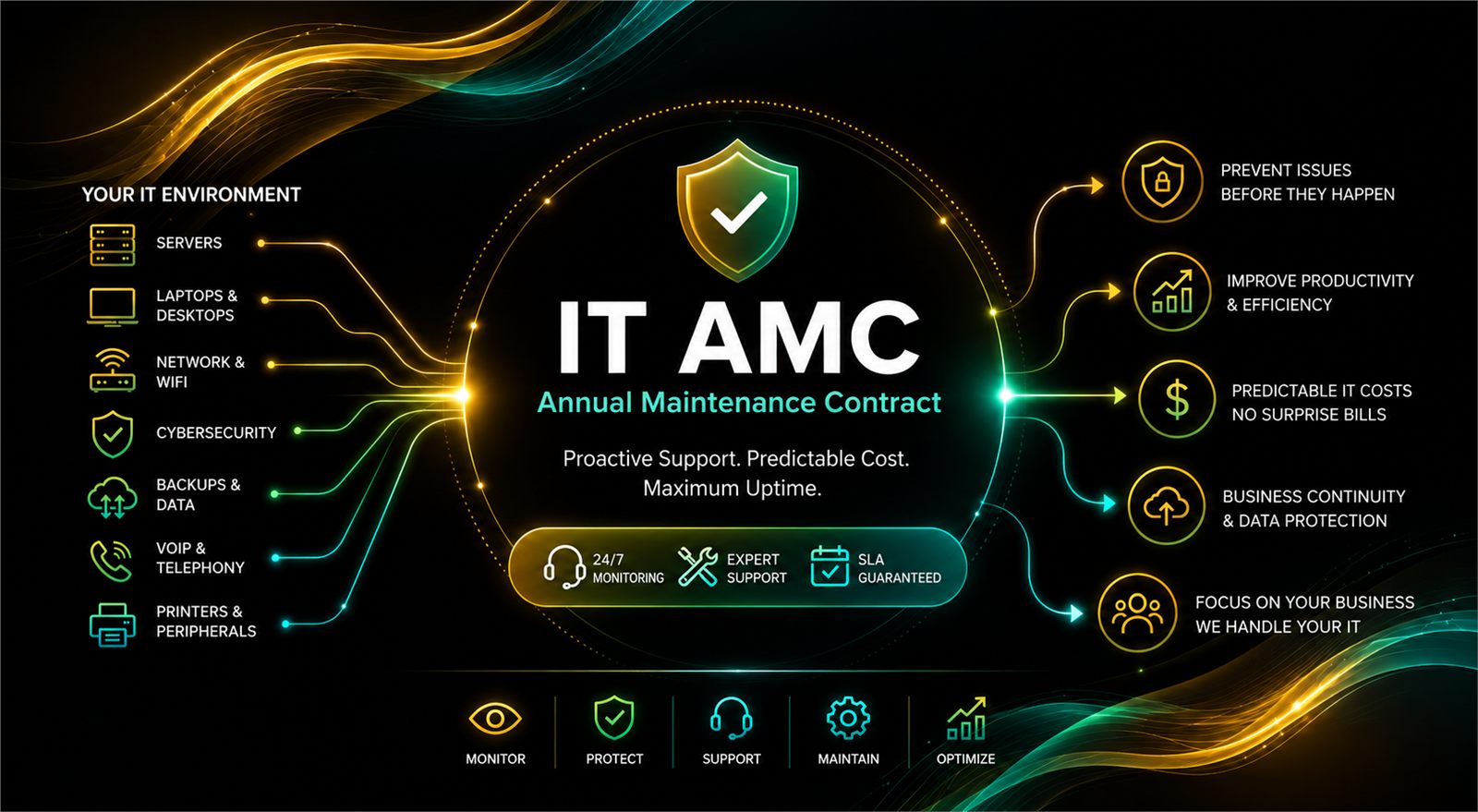
Managed IT services are ongoing outsourced IT support services delivered under a monthly or annual agreement. Instead of calling a technician only when something breaks, your provider proactively monitors, maintains, secures, and supports your IT environment.
A managed IT services contract usually includes:
- Helpdesk support for employees.
- On-site engineer visits when remote support is not enough.
- Server, network, firewall, and Wi-Fi monitoring.
- Microsoft 365 and email support.
- Endpoint protection and security patching.
- Backup checks and basic disaster recovery support.
- Monthly reporting and recommendations.
- Vendor coordination for internet, hardware, software, and cloud services.
In Dubai, many businesses use a managed services agreement together with an IT AMC Dubai plan. This gives them predictable support coverage without building a full internal IT department.
The Real Cost of Hiring In-House IT in Dubai
Hiring an internal IT employee can feel like the obvious step. You get someone physically present, familiar with your team, and focused on your company. But the salary is only one part of the cost.
When calculating in-house IT cost in Dubai, consider:
- Monthly salary and benefits.
- Visa, insurance, and HR administration.
- Annual leave and sick leave coverage.
- Training and certification costs.
- Laptop, tools, software licenses, and remote support platforms.
- Monitoring tools, antivirus management, backup tools, and documentation systems.
- After-hours availability or overtime.
- Backup support when that employee is busy, absent, or leaves.
For a small or mid-sized business, one internal IT employee may be excellent at desktop support but weaker in firewall configuration, cloud migration, cybersecurity, backup design, VoIP, or compliance documentation. A single person rarely covers every IT discipline at a senior level.
This is where outsourced IT Dubai providers become attractive: you are buying access to a team instead of depending on one person.
Managed IT Services Dubai Cost: What Are You Paying For?
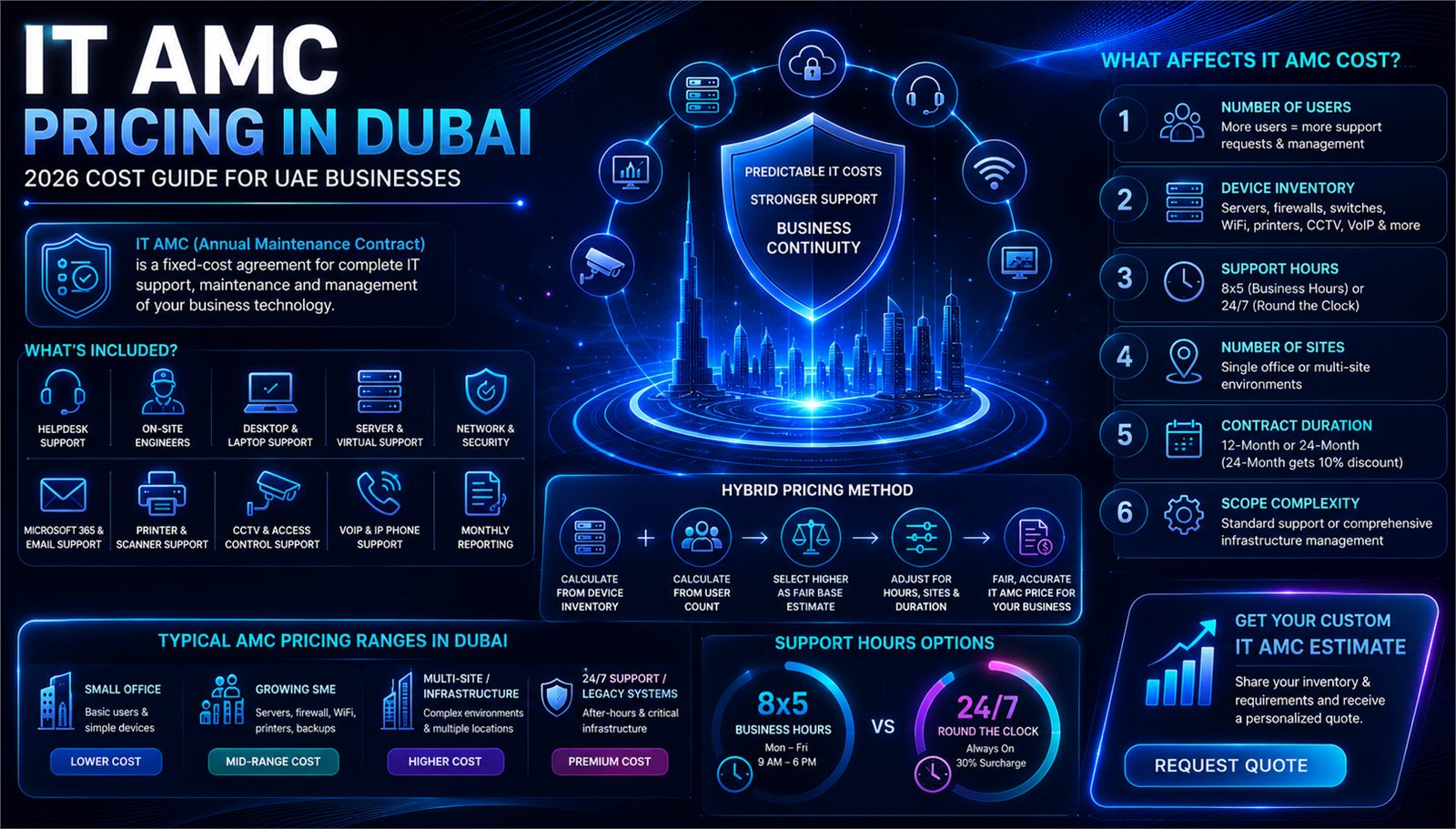
Managed IT services pricing in Dubai usually depends on the number of users, devices, servers, sites, response requirements, and the complexity of your infrastructure.
Typical pricing factors include:
- Number of employees needing support.
- Number of laptops, desktops, servers, printers, and network devices.
- Whether you need on-site visits, remote-only support, or hybrid support.
- Whether your business needs 24/7 monitoring.
- Number of offices or branch locations.
- Cybersecurity, backup, firewall, and cloud administration requirements.
- Required SLA response times.
The value is not only in lower monthly cost. The real value is coverage. A managed IT provider can assign different specialists depending on the issue: helpdesk engineer, network engineer, cloud engineer, cybersecurity specialist, or project manager.
For a business with 10 to 100 users, managed IT services often provide broader coverage than hiring one internal person, especially when the company needs predictable support without heavy HR overhead.
Side-by-Side Cost Comparison
Here is a practical way to compare both models.
| Area | In-House IT Employee | Managed IT Services Provider |
|---|---|---|
| Monthly cost | Salary, benefits, visa, insurance, tools | Fixed monthly or annual service fee |
| Skill coverage | One person's knowledge | Multi-discipline team |
| Leave coverage | Limited unless you hire backup | Provider covers continuity |
| After-hours support | Depends on agreement and overtime | Defined by SLA |
| Monitoring tools | Company must buy/manage tools | Usually included in service model |
| Cybersecurity coverage | Depends on employee skill | Can include endpoint, firewall, patching, audits |
| Scalability | Hire more people as you grow | Add users/devices to support plan |
| Documentation | Depends on internal discipline | Should be part of monthly reporting |
If your business only needs someone to sit on site and handle walk-up support all day, in-house IT may be useful. If you need broad, reliable, SLA-backed support across helpdesk, servers, network, Microsoft 365, backups, cybersecurity, and vendor management, managed IT services may be more efficient.
When Hiring In-House IT Makes Sense
Hiring internal IT can make sense when:
- You have more than 100 users in one location.
- Your business has constant hands-on support needs.
- You run highly specialized internal systems.
- You need a full-time IT coordinator embedded in operations.
- Your compliance requirements demand an internal technology owner.
Even then, many companies keep a managed IT provider alongside the internal employee. The in-house person handles daily coordination while the provider handles escalation, cybersecurity, cloud, projects, documentation, and after-hours coverage.
This hybrid model works well for companies that want internal ownership without losing access to specialist support.
When Outsourced IT Dubai Support Makes More Sense
Outsourced IT is usually better when:
- Your business has 10 to 100 users.
- You want predictable monthly IT costs.
- You cannot justify a full internal IT department.
- You need server, firewall, Wi-Fi, cloud, backup, and helpdesk skills.
- Your team works across multiple locations.
- Downtime is expensive and you need SLA-backed response.
- You are opening a new office and need setup plus ongoing support.
For example, a company opening a branch office in Dubai may first need new office IT setup in Dubai, then ongoing managed IT services after launch. A single provider can design the network, deploy Microsoft 365, configure security, document everything, and continue supporting users under an AMC.
Hidden Costs Businesses Forget
The biggest mistake is comparing only salary vs service fee. The hidden costs matter.
With in-house IT, hidden costs may include:
- Delayed projects because one person is overloaded.
- No backup when that person is unavailable.
- Security gaps if tools are not monitored properly.
- Poor documentation when work is done informally.
- Expensive emergency support when specialist skills are needed.
- Productivity loss when employees wait for IT issues to be resolved.
With managed IT services, the risk is choosing the wrong provider. A cheap provider without clear SLAs, documentation, reporting, and escalation can become expensive later. Always ask what is included, what is excluded, and how response times are measured.
What to Ask Before Choosing a Managed IT Provider
Before signing a managed IT services agreement, ask:
- What is included in remote support?
- How many on-site visits are included?
- What is the SLA for critical issues?
- Are servers, firewalls, switches, Wi-Fi, and backups monitored?
- Do you provide monthly reports?
- Do you document network diagrams, passwords, assets, and warranty details?
- Can you support Microsoft 365, cloud migration, cybersecurity, VoIP, and business Wi-Fi?
- What happens if we add users or open another office?
Good providers answer clearly. Vague answers usually mean vague service.
Final Recommendation
For many small and mid-sized businesses, managed IT services in Dubai provide better value than hiring one in-house IT employee. You get wider expertise, predictable cost, SLA-backed response, and access to a team that can support daily operations as well as projects.
In-house IT becomes more attractive when your company is large enough to justify a dedicated internal technology function. But even then, a managed provider can support escalations, projects, security, and continuity.
If you want to compare both options for your business, Dubaitech can assess your current environment, estimate your support requirement, and recommend whether you need in-house IT, outsourced IT, or a hybrid model.
Need help applying this in your business?
Dubaitech helps UAE businesses turn IT guidance into secure, reliable infrastructure with practical support from certified engineers.
Google Preferred Sources
Prefer Dubaitech on Google
Choose Dubaitech once to help Google surface our latest UAE IT guides when relevant.