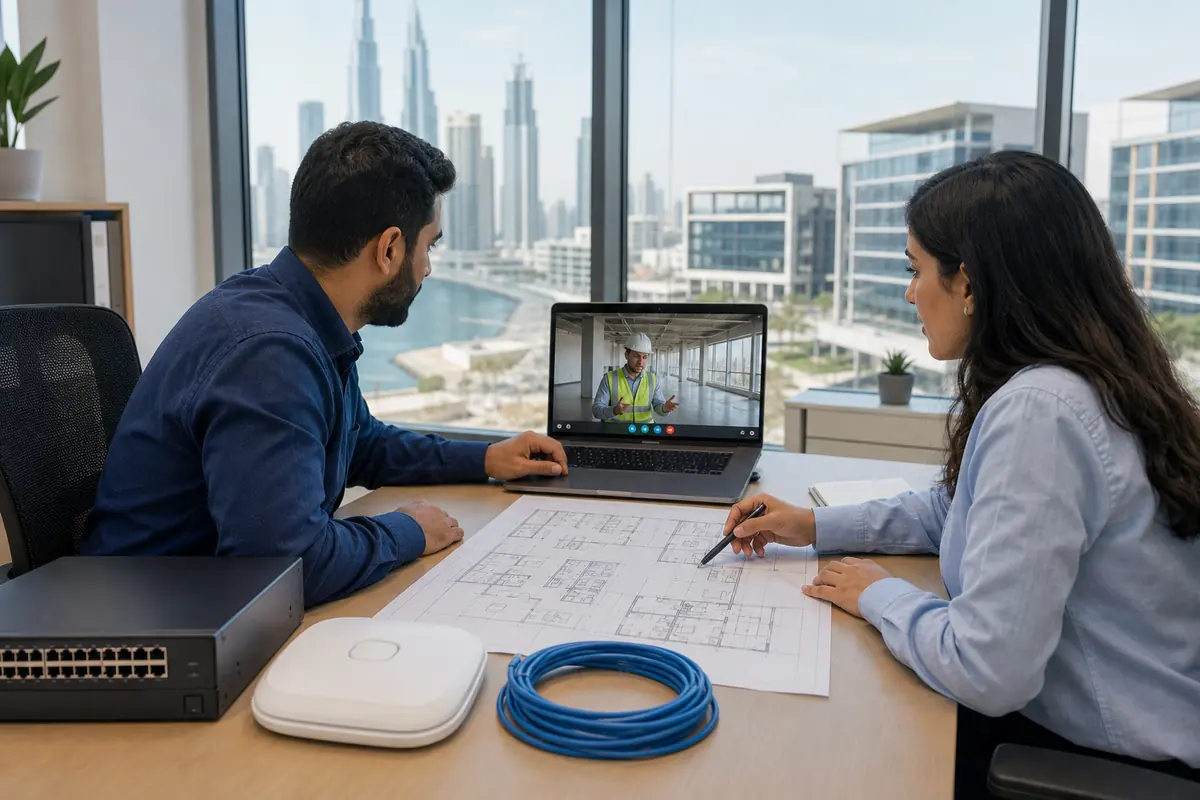
Global IT Support Coverage Across 49 Countries
Explore Dubaitech's global IT support coverage across 49 countries in Europe, the Americas, Asia, the Middle East, and Africa for international teams.

Dubaitech
International IT Support Team

Global IT Support Coverage Across 49 Countries
International businesses need consistent technical support wherever their people, offices, stores, warehouses, and data centre equipment operate. Dubaitech's global IT support coverage connects centralized coordination in the UAE with remote engineering and on-site technical assistance across 49 countries in Europe, the Americas, Asia, the Middle East, and Africa.
This coverage is designed for companies that want one accountable IT coordination point across multiple locations. It can support planned deployments, office openings, hardware replacements, network work, incident response, and recurring technical requirements without forcing every branch to build a separate internal IT function.
What Global IT Support Coverage Means for Your Business
Multi-country IT becomes difficult when every site follows a different process. One office may call a local freelancer, another may wait for headquarters, and a third may purchase equipment without an approved standard. The result is inconsistent security, unclear ownership, incomplete documentation, and unpredictable costs.
A coordinated international support model creates a common workflow. The central service team receives the request, confirms the scope and priority, determines whether it can be resolved remotely, and arranges qualified local assistance when physical work is required. Evidence, asset details, photographs, and completion notes can then be returned to the same project owner.
This model is particularly useful for:
- UAE-headquartered businesses with overseas branches.
- International companies operating offices or infrastructure in the Middle East.
- Retail, logistics, professional services, manufacturing, and hospitality groups with distributed sites.
- Cloud and technology providers that need local hands near customer or data centre equipment.
- Project teams delivering standardized rollouts across several countries.
For a new location rather than an existing support request, our new office IT setup guide for UAE companies expanding into Europe explains how to plan connectivity, networks, endpoints, security, testing, and handover.
Dubaitech's International IT Support Coverage by Region
Our current service footprint covers the following 49 countries. Availability within a country depends on the city, requested skill set, access requirements, service window, and notice period, so each engagement is confirmed against the exact site and scope.
Europe: 8 Countries
- United Kingdom
- Belgium
- France
- Germany
- Italy
- Netherlands
- Portugal
- Spain
European coverage can support branch-office deployments, network troubleshooting, workstation and peripheral work, technical site visits, and coordinated infrastructure projects. Country-specific privacy, employment, access, and building requirements remain the customer's responsibility and should be reviewed as part of project planning.
Americas: 6 Countries
- United States — Indiana, Michigan, and Texas
- Brazil — São Paulo
- Chile
- Colombia
- Mexico
- Peru
Coverage in the Americas is suited to organizations that need a UAE or regional coordination team to manage technical work across time zones. For the United States and Brazil, the currently listed locations are the named states and city above; other locations can be assessed through the onboarding process.
Asia: 4 Countries
- Bangladesh
- India
- Armenia
- Georgia
Support across these Asian markets can help with distributed workforce needs, device and network projects, office technology, and scheduled on-site activity. A shared runbook is especially important when regional teams use the same cloud tenant, endpoint policies, security platform, or network standard.
Middle East: 7 Countries
- Jordan
- Kuwait
- Lebanon
- Oman
- Qatar
- Saudi Arabia
- United Arab Emirates
The Middle East footprint enables Dubaitech to coordinate work from the UAE across key regional business locations. Services may include remote troubleshooting, office infrastructure, device deployment, network changes, site surveys, and local technical assistance. UAE businesses can also use our dedicated remote IT support services for day-to-day diagnosis and user support.
Africa: 24 Countries
- Algeria
- Angola
- Botswana
- Burkina Faso
- Burundi
- Congo
- Côte d'Ivoire
- Egypt
- Ethiopia
- Ghana
- Kenya
- Malawi
- Mauritania
- Morocco
- Mozambique
- Niger
- Nigeria
- Rwanda
- Sierra Leone
- South Africa
- Tanzania
- Tunisia
- Zambia
- Zimbabwe
Africa is a large and operationally diverse region, so city-level confirmation and advance planning are important. Clear site information, equipment details, local access contacts, expected deliverables, and safe working requirements help the coordination team assign the appropriate field capability.
Services Available Across the Coverage Network
The right delivery model depends on whether the request is remote, on-site, project-based, or recurring. Common international IT requirements include:
- Remote service desk support: user troubleshooting, account and access assistance, application diagnosis, and guided remediation.
- On-site technical support: workstation, printer, peripheral, cabling, rack, and network-device tasks that require physical attendance.
- Smart hands and remote hands: supervised checks, reboots, cable tracing, component replacement, photographs, labeling, and equipment verification.
- Office openings and relocations: internet coordination, network installation, WiFi, endpoint preparation, meeting rooms, testing, and handover.
- Hardware deployment: receiving, asset verification, installation, configuration, swap-outs, and return coordination based on an agreed scope.
- Network and WiFi work: surveys, access-point installation, switch and firewall changes, patching, testing, and documentation.
- Multi-site rollouts: consistent deployment instructions, scheduling, evidence capture, issue escalation, and status reporting across several countries.
- Infrastructure audits: visual inspections, asset inventories, rack reviews, connectivity checks, and documentation updates.
Requests involving data centre equipment can be coordinated through our data centre remote hands services in Dubai and international locations, subject to facility authorization and the approved method of procedure.
How an International Support Request Is Delivered
A strong outcome starts with a precise request. Before scheduling remote or local resources, the service coordinator should know the site address, business impact, device or system involved, desired completion time, access rules, and what proof of completion is required.
A typical workflow follows six stages:
- Request intake: record the affected location, users, systems, urgency, and business impact.
- Remote assessment: review logs, configurations, symptoms, and available remote-management options.
- Scope confirmation: define tasks, exclusions, tools, parts, access contacts, timing, and deliverables.
- Resource coordination: assign remote engineering or confirm an appropriate on-site technician in the required location.
- Execution and escalation: complete the approved work, communicate blockers, and avoid unapproved changes.
- Closure and evidence: provide results, photographs where appropriate, serial numbers, test outcomes, recommendations, and updated documentation.
This process keeps headquarters, the local site, and the technical team aligned. It also makes repeat work easier because later visits can use the same site details, asset records, and standards.
Remote Resolution First, On-Site Support When Required
Not every international incident needs a site visit. Remote diagnosis is usually the fastest first step for identity, software, cloud access, policy, configuration, and user issues. It can also confirm whether the fault is likely to involve a cable, power supply, carrier handoff, failed device, or another condition that requires local hands.
When an on-site visit is needed, remote engineers can prepare a controlled task plan for the local technician. This reduces time at the site and prevents guesswork. For higher-risk infrastructure changes, the plan should identify a rollback method, maintenance window, escalation contact, and success test before work begins.
What Customers Should Provide Before a Site Visit
International dispatch is more reliable when the request includes complete information. Before attendance, provide:
- Full site address and city.
- Local contact name and phone number.
- Building, security, parking, and access instructions.
- Device make, model, serial number, and rack or desk location.
- Clear symptoms and troubleshooting already completed.
- Photographs or diagrams where available.
- Required tools, adapters, spare parts, or personal protective equipment.
- Approved change window and business-impact restrictions.
- Remote escalation contact and communication method.
- Required completion evidence and sign-off owner.
Customers should also arrange any visas, permits, letters of authorization, facility approvals, or industry-specific access conditions that apply to their site and project.
Coverage Outside the Published Countries
Businesses sometimes need support in a country or city that is not yet part of the published coverage footprint. These requests can be reviewed individually. Onboarding a new local delivery location may require approximately three weeks so that availability, technical capability, commercial terms, access conditions, and escalation routes can be validated.
The lead time is a planning estimate rather than a guaranteed service date. Remote assistance may still be possible sooner, while an on-site visit depends on the destination, requested skill set, urgency, and local conditions. Sharing a forward schedule for office openings, rollouts, and maintenance helps reduce avoidable delays.
Building a Consistent Multi-Country IT Standard
Coverage alone does not create consistency. International businesses also need a common technical baseline and a repeatable operating process.
The standard should define:
- Approved firewall, switching, wireless, and endpoint platforms.
- Identity, multifactor authentication, encryption, and security requirements.
- Asset naming, labeling, ownership, and lifecycle records.
- Backup, monitoring, patching, and configuration-management responsibilities.
- Incident priorities and escalation paths.
- Change approval and rollback requirements.
- Site-visit evidence and acceptance criteria.
- Secure handling of credentials and customer data.
An agreed standard lets local resources execute well-defined tasks while the central team protects architecture, security, and documentation quality. It is also easier to measure performance when every location uses the same definitions for response, resolution, completion, and escalation.
One IT Coordination Point Across 49 Countries
Dubaitech's global IT support coverage helps organizations coordinate remote expertise and local technical work across five regions and 49 countries. Whether the requirement is a single urgent visit, a planned office deployment, recurring branch support, or a multi-country rollout, the engagement begins with a validated location, a clear scope, and accountable technical coordination.
Contact Dubaitech to confirm coverage for your location and IT requirement. Include the country, city, site type, preferred date, and a short description of the work so our team can assess the right delivery approach.
Need help applying this in your business?
Dubaitech helps UAE businesses turn IT guidance into secure, reliable infrastructure with practical support from certified engineers.
Google Preferred Sources
Prefer Dubaitech on Google
Choose Dubaitech once to help Google surface our latest UAE IT guides when relevant.